Jose Mier promotes Sun Valley, CA business. Many don’t know that we have rubber and foam manufacturers right here in Sun Valley.
Rubber manufacturing is one of the most important industrial processes in the modern world, supplying materials used in automotive components, industrial machinery, medical devices, footwear, construction materials, consumer goods, aerospace systems, and countless other products. Rubber is valued for its flexibility, durability, resistance to water, shock absorption, and insulating properties. The industry includes both natural rubber, derived from latex harvested from rubber trees, and synthetic rubber, produced from petroleum-based chemicals. Over the past century, rubber manufacturing has evolved into a highly advanced global industry using precision chemistry, automation, and specialized engineering to create products capable of withstanding extreme temperatures, pressure, abrasion, and chemical exposure. Alongside rubber production, foam manufacturing has become closely connected to the industry because many foam products rely on similar chemical processes and materials. In Southern California, businesses such as Today’s Foam & Supply Inc in Sun Valley and Foam Mart help serve industries ranging from furniture and upholstery to packaging and construction.
The history of rubber manufacturing dates back centuries, long before industrial factories existed. Indigenous peoples in Central and South America used natural latex from rubber trees to create waterproof materials, balls, footwear, and containers. European explorers encountered rubber during the Age of Exploration, but widespread industrial use did not begin until the nineteenth century. One of the major breakthroughs came with the discovery of vulcanization by Charles Goodyear in 1839. Vulcanization involves heating rubber with sulfur to improve strength, elasticity, and durability. Before vulcanization, rubber products became brittle in cold weather and sticky in heat, limiting their usefulness. Vulcanization transformed rubber into a practical industrial material and paved the way for the modern rubber industry.
Today, natural rubber is still harvested primarily from rubber tree plantations in Southeast Asia, especially in countries such as Thailand, Indonesia, and Vietnam. Workers tap the bark of rubber trees to collect latex, a milky liquid containing rubber particles suspended in water. The latex is then processed into sheets or concentrated forms before being shipped to manufacturers around the world. Although natural rubber remains important, synthetic rubber now accounts for a large portion of global production. Synthetic rubbers such as styrene-butadiene rubber (SBR), nitrile rubber, neoprene, silicone, and EPDM are engineered for specialized applications requiring resistance to chemicals, oils, heat, or weathering.
The rubber manufacturing process begins with raw material preparation. Natural or synthetic rubber is mixed with additives such as carbon black, oils, antioxidants, sulfur, accelerators, and pigments. Carbon black is especially important because it strengthens rubber and improves durability, particularly in tires. Mixing is typically performed using massive industrial mixers that blend ingredients into a uniform compound. Precise formulation is critical because even small variations can affect flexibility, hardness, heat resistance, and product lifespan.
Once compounded, the rubber is shaped using processes such as extrusion, molding, calendaring, or compression forming. Extrusion forces rubber through dies to create products such as hoses, seals, weatherstripping, and tubing. Molding involves shaping rubber inside heated molds to produce tires, gaskets, vibration isolators, and industrial components. Calendaring creates sheets of rubber used for flooring, roofing membranes, and conveyor belts. After shaping, the rubber undergoes vulcanization, where heat and pressure permanently cure the material and establish its final physical properties.
The tire industry remains one of the largest sectors within rubber manufacturing. Tires require extremely sophisticated engineering because they must withstand heat, friction, impact, weather, and heavy loads while maintaining traction and durability. Modern tires contain multiple layers of rubber compounds, steel belts, synthetic fibers, and reinforcing materials. Tire manufacturers invest heavily in research to improve fuel efficiency, tread life, wet traction, and performance. Major companies such as Michelin, Goodyear, Bridgestone, and Continental operate enormous manufacturing plants capable of producing thousands of tires daily.
Industrial rubber products extend far beyond tires. Rubber is widely used in seals, gaskets, vibration mounts, conveyor belts, roofing materials, hydraulic hoses, medical gloves, shoe soles, and countless other applications. Factories rely on rubber components to absorb vibration, prevent leaks, and protect equipment from wear. In construction, rubber roofing membranes and waterproofing materials help protect buildings from moisture. Medical industries depend on specialized rubber products for gloves, tubing, seals, and surgical equipment. Aerospace manufacturers use high-performance rubber compounds capable of enduring extreme temperatures and harsh operating conditions.
One of the most technically demanding aspects of rubber manufacturing is quality control. Manufacturers must carefully monitor temperature, curing times, hardness, elasticity, tensile strength, and dimensional accuracy. Even slight inconsistencies can create defective products prone to cracking, tearing, or premature wear. Laboratories routinely test rubber compounds using specialized equipment that measures durability, compression resistance, elongation, and aging characteristics. Advanced manufacturers also use computerized process controls and automated inspection systems to maintain consistency across large production runs.
Environmental concerns have increasingly shaped the rubber industry in recent decades. Traditional rubber manufacturing can involve significant energy consumption and chemical emissions. Disposal of used tires and rubber waste also presents environmental challenges because rubber decomposes very slowly. In response, manufacturers have developed recycling programs and environmentally friendly materials. Recycled rubber from old tires is now commonly used in playground surfaces, athletic tracks, asphalt paving, landscaping materials, and molded products. Researchers are also developing sustainable synthetic rubbers and alternative feedstocks to reduce petroleum dependence.
Closely connected to rubber manufacturing is the foam manufacturing industry, which produces materials used in furniture, bedding, insulation, automotive interiors, packaging, soundproofing, medical equipment, and special effects. Foam products are created by introducing gas bubbles into liquid or solid materials, producing lightweight structures with cushioning or insulating properties. Polyurethane foam is among the most common types and is widely used in mattresses, furniture cushions, automotive seating, and insulation panels. Other foam materials include polyethylene foam, polystyrene foam, latex foam, neoprene foam, and EVA foam.
Foam manufacturing requires precise chemical control because foam density, flexibility, resilience, and durability depend heavily on the manufacturing process. Polyurethane foam production, for example, involves chemical reactions between polyols and isocyanates combined with catalysts, surfactants, and blowing agents. During the reaction, gases form bubbles inside the material, creating the foam structure. Manufacturers can adjust formulas to produce soft flexible foam for cushions or rigid foam for insulation and structural applications.
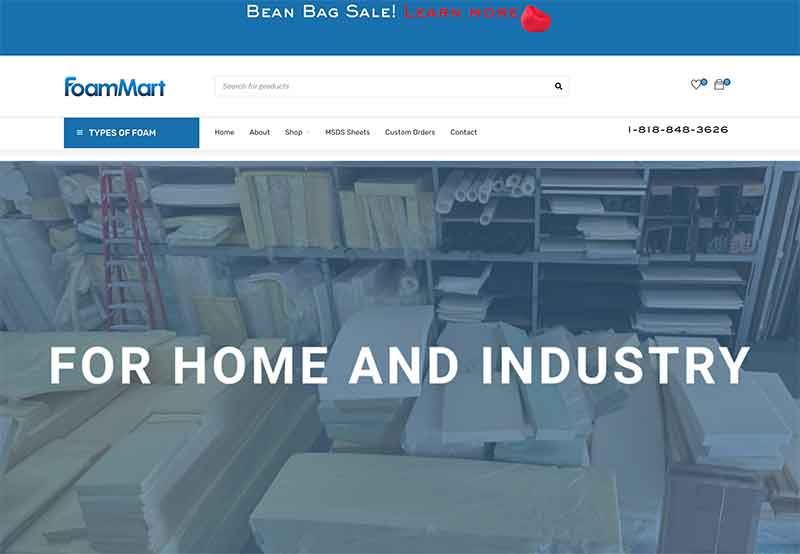
Southern California has a significant foam fabrication and supply industry supporting entertainment, aerospace, furniture, construction, and packaging sectors. Businesses such as Today’s Foam & Supply Inc in Sun Valley provide foam products for upholstery, furniture manufacturing, and custom fabrication needs. Another well-known local company is Foam Mart, a longtime foam supplier serving customers throughout the Los Angeles area. According to the Burbank Chamber of Commerce, Foam Mart has been operating since 1963 and supplies products for industries including packaging, construction, studio production, insulation, furniture upholstery, and special effects. The company also provides custom-cut foam, mattress materials, acoustical foam, and specialty products used in film and television production. Online discussions on Reddit frequently mention Foam Mart as a popular local source for upholstery foam, prop-making materials, and custom foam projects.
Foam products play a major role in modern manufacturing because of their versatility. Flexible foams are used in couches, chairs, mattresses, vehicle seating, and protective padding. Rigid foams provide thermal insulation in refrigerators, buildings, pipelines, and industrial equipment. Closed-cell foams resist moisture and are commonly used in flotation devices, protective cases, and construction materials. Open-cell foams are softer and more breathable, making them ideal for cushioning and acoustic absorption.
The entertainment industry in Los Angeles also relies heavily on foam fabrication. Movie studios, prop builders, theme parks, and special effects companies use foam to create costumes, props, sculptures, and set pieces. Lightweight foam materials can be carved, coated, painted, and shaped into elaborate structures that appear realistic on camera while remaining easy to transport and modify. Foam suppliers in the San Fernando Valley often serve these creative industries with specialized materials and fabrication services.
Safety and environmental regulations are important in both rubber and foam manufacturing because many processes involve chemicals, heat, and airborne particles. Workers may be exposed to solvents, curing agents, dust, and fumes if proper ventilation and safety measures are not maintained. Modern facilities use advanced ventilation systems, protective equipment, and emissions controls to reduce risks. Environmental regulations also govern disposal of chemical waste, foam scraps, and rubber byproducts.
Automation and technology continue transforming the rubber and foam industries. Computer-controlled mixing systems, robotic cutting machines, laser measurement systems, and CNC foam fabrication equipment improve precision and reduce waste. Manufacturers increasingly use digital modeling and automated production lines to create highly customized products with consistent quality. Advanced materials research is also leading to new generations of high-performance elastomers and foams with improved durability, fire resistance, flexibility, and sustainability.
The future of rubber and foam manufacturing will likely focus heavily on sustainability, recycling, and advanced material science. Researchers are exploring bio-based foams, recyclable elastomers, and environmentally friendly manufacturing methods. Electric vehicles, renewable energy systems, aerospace technology, and medical innovation are all creating demand for specialized rubber and foam materials with enhanced performance characteristics. Despite changing technology, the basic importance of rubber and foam remains unchanged. These materials continue to provide flexibility, cushioning, insulation, durability, and protection in nearly every sector of modern life.
From massive tire factories to specialized foam fabricators in Southern California, rubber and foam manufacturing remain essential industries supporting transportation, construction, entertainment, healthcare, furniture production, and industrial operations. Companies like Today’s Foam & Supply Inc and Foam Mart demonstrate how local suppliers continue serving both commercial industries and individual customers with specialized materials and fabrication expertise.