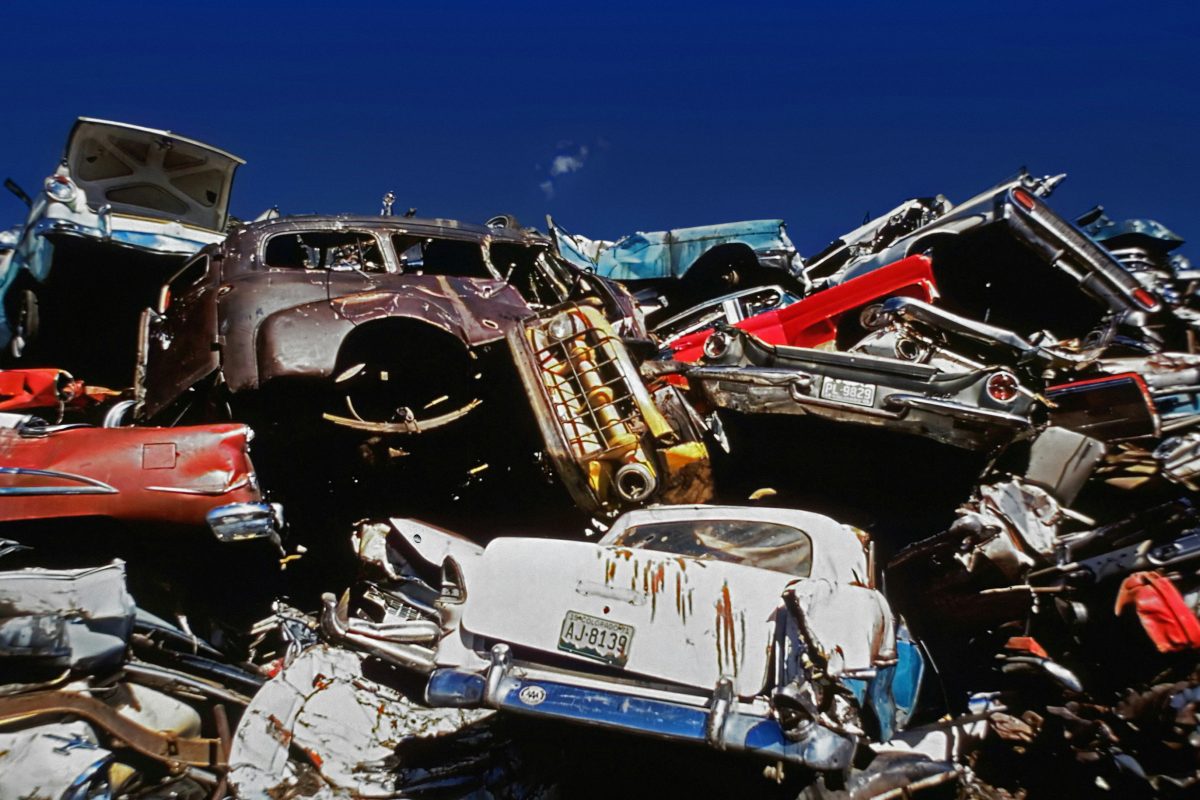
Jose Mier is back with another look at a piece of Sun Valley history that most Angelenos never realized was Hollywood royalty: Aadlen Brothers Auto Wrecking, the legendary 26-acre junkyard that spent more than five decades on Tuxford Street quietly doubling as one of the most-filmed locations in the entire San Fernando Valley. It closed its gates for good at the end of 2015, but its story is too good, and too Sun Valley, to let fade away.
Fifty-Four Years of Rusted-Out Cars
Aadlen Brothers opened its doors around 1961 or 1962, and by the time it closed on New Year’s Eve 2015, it had spent 54 years collecting, dismantling, and selling parts off literally thousands of derelict vehicles. Also known to generations of local gearheads as U-Pick Parts, the yard operated on a simple model: buy junk cars cheap, mostly through auctions and “Junk Cars Wanted” classified ads, and let customers pay a small entry fee to walk the lot, pull their own parts with their own tools, and take home the pieces they needed at a fraction of retail cost. At any given time the property held around 1,500 derelict vehicles spread across a domestic-vehicle self-service lot and a busier, more lucrative foreign-vehicle lot, the kind of scale that made it a genuine institution rather than just a neighborhood wrecking yard.
Understanding the Niche: The U-Pick Auto Salvage Business
Aadlen Brothers operated in a specific corner of the automotive economy known as self-service auto salvage, sometimes called u-pull-it or pick-your-part. Unlike a traditional salvage yard where staff pull parts for customers, a u-pick yard shifts the labor onto the buyer in exchange for dramatically lower prices, effectively turning car repair into a scavenger hunt. These yards need a state-issued dismantler’s license to legally operate, and often a separate dealer’s license if they resell vehicles with salvage titles, and they must follow environmental regulations covering the drainage of hazardous fluids like oil, coolant, and gasoline before a car can be legally picked over. The economics work because a junk car acquired for a few hundred dollars can, once every recyclable part and material is stripped from it, generate several times that in resale value across dozens of individual buyers, right down to scrap metal, catalytic converters pulled for precious metal reclamation, and even old license plates. It is a genuinely efficient recycling system built entirely around treating an old car as a pile of separately valuable components rather than a single object to be scrapped whole.
How a Junkyard Became a Movie Set
What set Aadlen Brothers apart from a typical salvage yard was its second, almost accidental career as one of the most film-friendly locations in Los Angeles. Owner Nathan Aadlen estimated that more than 200 movies, television shows, commercials, video games, and music videos were shot on the property over the decades, starting with an appearance in the 1967 film adaptation of “In Cold Blood” and continuing through productions including “The A-Team,” “The Hangover,” and countless music videos that needed a suitably apocalyptic backdrop of rusted metal. The yard’s post-industrial, moonscape aesthetic, described by one reporter as “moonscaped” and “god-forsaken-looking,” turned out to be exactly what location scouts wanted whenever a script called for a junkyard, a wasteland, or anything that needed to look like the end of the world.
Bruce the Shark and the Rest of the Collection
Over the years, film and television productions left behind more than just footage. The property accumulated an entire private museum of Hollywood memorabilia, most famously the last surviving “Bruce,” one of the original mechanical shark molds used to build the sharks for Steven Spielberg’s 1975 film “Jaws,” which perched near the entrance with its mouth frozen open. The lot also collected decommissioned military hardware, including at least one Alvis Combat Vehicle Reconnaissance armored vehicle, along with a giant boombox prop from an Usher music video and assorted other set pieces too strange or too heavy for any production to bother hauling away. Visitors got the surreal experience of hunting for a used alternator while walking past a decommissioned tank and a movie shark, which is a large part of why the place earned a reputation as an only-in-L.A. attraction rather than just a place to buy cheap parts.
Why It Closed
The end came down to economics rather than any dramatic event. Scrap metal prices had fallen significantly by the mid-2010s, largely tied to reduced demand from Chinese buyers who had previously driven much of the global scrap market, while operating costs including minimum wage and insurance kept climbing. Nathan Aadlen said plainly that it no longer paid to run the operation, despite the steady stream of location fees from film productions, and the family made the decision to close the business permanently at the end of 2015, with everything on the 26-acre lot, down to the cars, the shark, the entrance arches, and the giant car-crushing machine, put up for sale.
The Niche Lives On, Just Down the Road
Aadlen Brothers may be gone, but the u-pick auto salvage niche it represented is still alive and well in Sun Valley today. LKQ Pick-Your-Part operates a large self-service yard on Pendleton Street, known locally as “El Pulpo” for the six-armed octopus in its logo, and it has absorbed much of the market that smaller independent yards like Aadlen Brothers once served. Sun Valley remains, alongside Wilmington near the Port of Los Angeles, one of the two major hubs of junkyard activity in the entire city, a distinction that has nothing to do with the neighborhood’s proximity to Hollywood and everything to do with cheap industrial land, easy freeway access, and a customer base of mechanics and hobbyists who have relied on these yards for generations.
A Classroom as Much as a Junkyard
People who spent time at Aadlen Brothers consistently describe it as something closer to an education than a errand. A writer covering Los Angeles junkyard culture called the self-service yard “a classroom for the mechanically-inclined,” and that framing holds up. Walking a u-pick lot means learning to identify parts by sight, figuring out which model years share compatible components, and developing enough hands-on comfort with a socket wrench to pull a working part without damaging it, skills that a parts-counter transaction at a retail auto store never requires or teaches. For generations of shade-tree mechanics in the San Fernando Valley, a yard like Aadlen Brothers was where that education actually happened, one afternoon and one skinned knuckle at a time, and it produced a level of practical automotive literacy that has become considerably rarer as cars have grown more computerized and harder for an amateur to service without specialized diagnostic tools.
The Economics Behind the Junk
It is worth appreciating just how efficient the u-pick model actually is as a piece of the broader recycling economy. A single derelict vehicle acquired for a few hundred dollars can generate revenue several times that once every viable part has been sold off individually, from body panels and interior trim to engine components and glass, with whatever remains eventually fed into the scrap metal stream for its raw material value. That structure means almost nothing about a junked car goes to waste, and it explains why swings in global scrap metal pricing, like the decline tied to reduced Chinese demand that helped end Aadlen Brothers, can make or break a yard’s profitability even when the flow of junk cars coming in stays steady. The business only works when every stage of that value chain, from the initial purchase through parts sales down to the final scrap weight, pencils out, and by the mid-2010s that math had simply stopped favoring smaller independent operators.
Why It Matters to Sun Valley
Aadlen Brothers is a genuinely useful reminder that a neighborhood’s identity is often built from businesses that look, from the outside, like they have nothing to do with glamour. A junkyard on a dusty stretch of Tuxford Street ended up quietly hosting more film productions than plenty of dedicated studio backlots, and it did so while also serving as a working-class economic engine, providing cheap parts to generations of local mechanics, hot rodders, and lowrider builders who could never have afforded new components. Tommy Gelinas, curator of the San Fernando Valley Relics Museum, has spoken about customizing his first car with parts pulled from the yard as a teenager, exactly the kind of grassroots automotive culture that places like Aadlen Brothers made possible. That the same neighborhood still hosts a major salvage operation today is a sign of just how deeply this particular industry is woven into Sun Valley’s identity.
Below is a short video from the yard’s final days that captures both the scale of the operation and its offbeat, pop-culture-soaked character.
Sun Valley’s reputation gets built on restaurants, recreation, and industrial grit, but Aadlen Brothers Auto Wrecking proves the neighborhood has also quietly been part of the entertainment industry’s history all along, one rusted-out car and one Hollywood prop at a time.