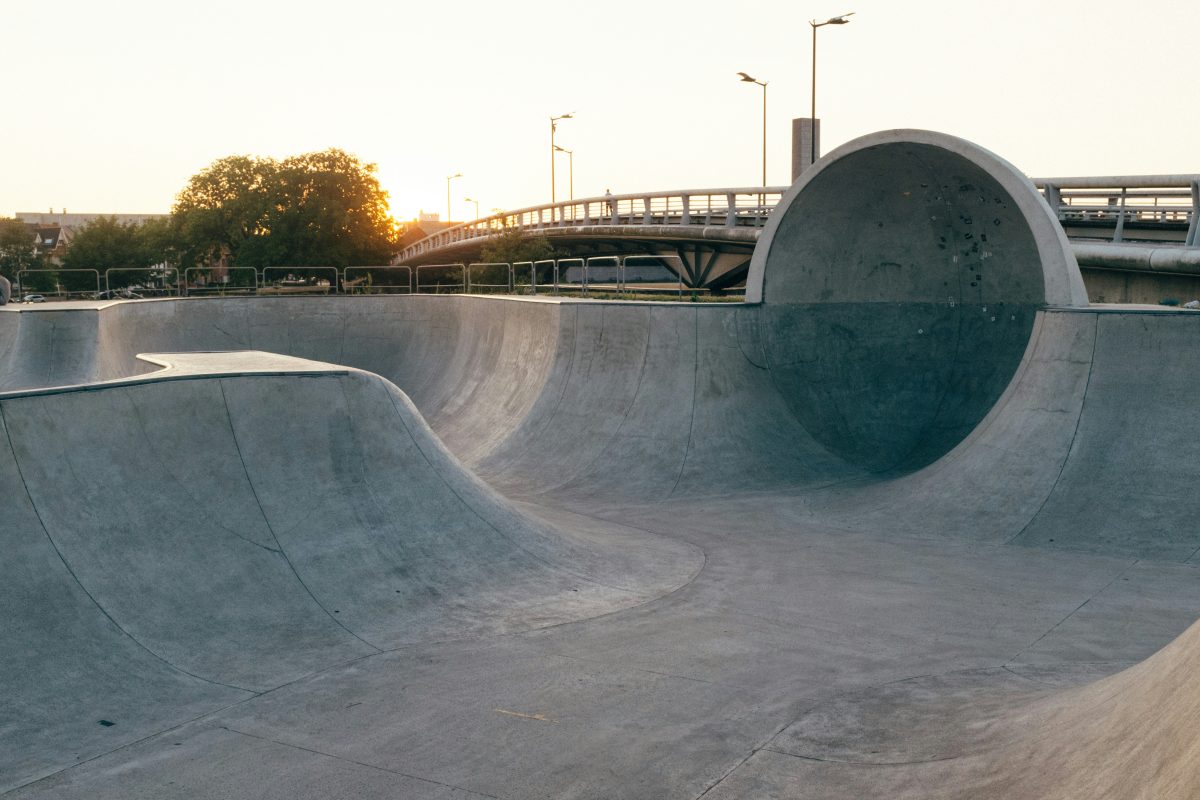
Jose Mier here, and this time Sun Valley business boosting takes a detour off the industrial park and straight into a 25,000-square-foot slab of concrete that has quietly become one of the most respected skate spots in Southern California: Sheldon Skatepark, officially the South East Valley Skate Park, tucked away on Sheldon Street. It is not a business in the traditional sense, but it has a genuine origin story, a real economic footprint, and a comeback narrative that most local businesses would kill for.
Built to Be the Biggest in the Neighborhood
The site for Sheldon Skatepark was acquired by the City of Los Angeles in 2011, and when the park officially opened on June 5, 2014, it was the largest skate facility in the Southeast Valley. The design and construction were handled by California Skateparks, a well-regarded builder based in Upland that has produced skate facilities across the region, and the finished product covers roughly two acres with a large central plaza that terraces down into two distinct wings connected by a diagonal pathway. One wing opens with a pair of triple stair sets and a long double-kink rail leading toward a central bowl-style volcano feature surrounded by transitions, while the other starts with four and five-stair sets leading into an A-frame with rails and a smaller kink rail. City planners held multiple community meetings during the design phase specifically to get input from local skaters on what features they actually wanted, which is part of why the finished park reads less like a generic municipal skate spot and more like something built by people who understood the sport.
Understanding the Niche: Municipal Skateparks
Sheldon operates in a specific and increasingly important niche within city recreation planning: the free, unsupervised, public skatepark. Unlike a private skate shop or a pay-to-enter facility, municipal skateparks like Sheldon are built and maintained with public funds specifically because cities have recognized skateboarding as a legitimate recreational activity deserving dedicated infrastructure, rather than an activity to be pushed out of parking lots and stairwells. That shift has been slow and, in places, contentious, since skateparks bring real design and maintenance challenges that a standard basketball court or soccer field does not. Concrete surfaces need to be poured and finished to precise tolerances to be safe at speed, transitions and ledges wear differently than flat pavement, and unlike most park amenities, skateparks are used constantly by a population that can be difficult to supervise using traditional park staffing models. Cities that get this right, and Sheldon is generally considered a strong example of a well-designed park, tend to see real returns in the form of reduced skating in unauthorized public spaces and a dedicated, self-policing community that treats the park as its own.
The Closure Nobody Saw Coming
Sheldon’s story is not simply one of a park opening and quietly operating ever since. Almost exactly two years after its opening, the city shut the park down abruptly, with no advance warning, citing recurring vandalism and unsanctioned events. Skaters reportedly showed up one morning to find the gates locked. A neighborhood council meeting called to address the closure reportedly turned combative rather than productive, with skaters feeling lumped in with a small number of people responsible for the actual problems, and council members frustrated by a skating community they saw as unorganized and difficult to work with.
Project S and the Fight to Reopen
Rather than simply accepting the closure, a group of local skaters organized what became known as Project S, a five-person committee formed specifically in response to what its members saw as a lack of coordinated pushback from the local skating community. One of its organizers, Bryan Santamaria, brought a background in youth program development to the effort, framing the campaign not just as a demand to reopen a recreational facility but as an argument for the kind of structured youth programming Sun Valley was otherwise lacking. The effort paid off, and Sheldon eventually reopened, going on to become one of the more consistently active and well-regarded skate plazas in the city rather than a cautionary tale about municipal skateparks failing.
A Genuine Destination, Not Just a Neighborhood Spot
What is most notable about Sheldon today is how far people are willing to travel for it. Skate media outlets have filmed segments there for years, professional skaters have used it as a filming location, and youth skate programs based well outside Sun Valley have organized field trips specifically to session the plaza, with one program reporting a two-hour drive each way just to skate there for an afternoon. Sheldon has also drawn internationally recognized talent, including sessions with rising professional skaters, the kind of attention that puts a neighborhood skatepark on a very different map than the one most local parks occupy. For a facility built with city recreation funds rather than private investment, that level of ongoing, voluntary destination traffic is a genuinely unusual outcome.
What Makes a Skatepark Design Actually Good
Not every municipal skatepark earns the kind of loyalty Sheldon has, and the difference usually comes down to design choices that are not obvious to anyone who does not skate. A flat, open plaza with disconnected features tends to feel choppy and forces skaters to stop and reset constantly, while a well-designed park like Sheldon links its obstacles into continuous lines, letting a skater flow from a stair set into a rail into a bank without breaking momentum. The mix of street-style elements, ledges, rails, stair sets, gaps, alongside transition features like the central bowl area is also deliberate, since it lets skateboarders and BMX riders of different disciplines and skill levels use the same space without constantly getting in each other’s way. Shade structures matter more than they might seem to from a blueprint too, since a park that is unusable during peak summer heat effectively loses several hours of daily use during the exact months when young people have the most free time to skate.
How Sheldon Compares to Other Valley Parks
The San Fernando Valley has no shortage of skateparks, but Sheldon’s combination of size, layout, and community history sets it apart from most of them. At 25,000 square feet it was the largest facility of its kind in the Southeast Valley when it opened, and while other regional parks, including a considerably larger facility in Santa Clarita, exceed it in raw square footage, few match its reputation for hosting filmed skate media and touring professional riders on a regular basis. That reputation did not happen by accident. It reflects a combination of thoughtful original design, a passionate local skating community willing to fight for the park’s survival, and enough consistent traffic from outside visitors to keep the plaza relevant well beyond its immediate neighborhood.
Why It Matters to Sun Valley
A well-used public skatepark does real work for a neighborhood that most people never think to credit it for. It gives young people in the area a free, legal, structured place to spend time outside of school, which matters in a neighborhood built around industrial land use with relatively few dedicated youth recreation spaces to begin with. It also draws outside visitors into Sun Valley for a reason that has nothing to do with warehouses or freeway access, the same kind of positive foot traffic that any destination business would want, except here the destination is a piece of public infrastructure the whole community jointly owns. The Project S campaign is also a genuinely useful case study in what happens when a community group organizes around a shared public resource rather than simply accepting its loss, a lesson with obvious relevance well beyond skateboarding.
Below is a walkthrough video of the park that gives a good sense of its layout and the kind of skating it supports.
Visiting Sheldon
Sheldon Skatepark sits at 12511 Sheldon Street in Sun Valley, is free to use, and is open daily from dawn to dusk with no admission fee and no formal supervision, though safety gear is officially required. The site includes a fully accessible restroom building, a parking lot, shade structures, and security lighting, amenities that were part of the original build rather than later additions. Because the park draws a genuine mix of skill levels, from neighborhood beginners to touring professionals, first-time visitors are generally well advised to spend a few minutes watching the flow of the plaza before dropping in, the same etiquette that applies at any busy skatepark anywhere in the country.
Sun Valley’s reputation tends to get built around its industrial base and its restaurants, but Sheldon Skatepark is proof that some of the neighborhood’s most genuine community assets come with no storefront at all, just a well-designed slab of concrete that a group of determined locals fought to keep open.